

Van lifers, long-distance RV travelers and remote off-grid cabin owners all face one shared pain point when building independent power systems: rigid framed solar panels come with heavy weight, drilling risks and poor adaptability to curved vehicle roofs. For years, flexible solar modules have been marketed as a lightweight, drill-free alternative—but many users still wonder if the higher upfront cost and shorter service life tradeoffs make them a worthwhile investment for RV and off-grid setups.
This guide breaks down every real-world advantage, limitation and matching scenario of flexible solar modules, paired with practical product insights from Toenergy, a Hangzhou-based PV manufacturer with 14 years of experience producing certified flexible and rigid solar panels for global mobile and off-grid markets. Whether you’re building a small weekend camper power system or a full-time off-grid RV energy setup, this unbiased breakdown helps you decide if flexible solar modules fit your unique power needs.
Core Advantages That Make Flexible Solar Modules Ideal For RV & Off-Grid Use
For mobile off-grid users, the biggest strengths of flexible solar modules directly solve the pain points of traditional rigid glass panels:
1. Ultra-lightweight design cuts vehicle load and fuel consumption
A standard 200W rigid solar panel weighs over 12kg, while a comparable HPBC flexible solar module from Toenergy weighs less than 2.8kg. For lightweight RVs, small vans and travel trailers, extra rooftop weight increases highway fuel consumption and raises vehicle center of gravity, creating safety risks during cross-country travel. Flexible panels eliminate this burden, allowing users to stack more wattage on the roof without overloading the vehicle chassis. Even for remote off-grid cabins with thin corrugated metal roofs, their low weight removes the need for structural reinforcement required for heavy framed panels.
2. Drill-free adhesive installation protects RV roof integrity
Rigid solar panels demand drilling mounting holes through RV roof membranes, which creates permanent leak risks if sealing fails over time. High-quality flexible PV modules use marine-grade VHB tape or industrial silicone adhesive for full flush mounting, no drilling required. The panel lies flat against curved RV roof contours without air gaps, cutting down wind drag during driving and lowering wind noise on the road. DIY RV owners can complete full installation in half a day without professional construction tools, a massive plus for self-built off-grid power kits.
3. Curved surface adaptability unlocks extra power space
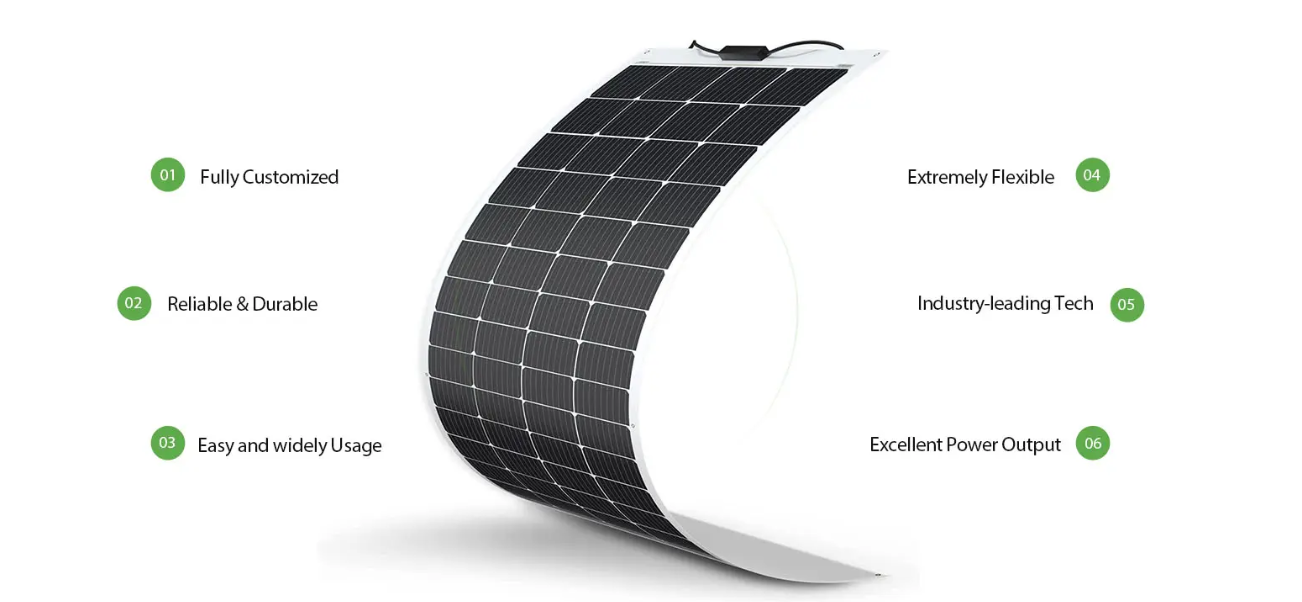
Most RVs, campers and boats feature arched, rounded rooflines where rigid square panels cannot fit. Flexible solar modules bend up to 30 degrees to follow vehicle curves, letting users fill every available rooftop inch to boost total charging wattage. For remote off-grid sheds with uneven metal roofing, they conform to surface undulations that rule out standard framed panels entirely. Toenergy’s flexible HPBC cells eliminate front gridline shading, delivering stable power output even when slightly bent without microcracking, a critical upgrade over older low-grade flexible modules prone to internal cell damage after bending.
4. Portable backup power for temporary off-grid scenarios
Beyond permanent rooftop mounting, foldable flexible solar panel kits double as portable power sources for camping, hiking and emergency remote sites. Users can roll or fold lightweight panels for storage in RV storage compartments, setting them up on the ground to supplement rooftop charging on heavily shaded days. IP67 waterproof ETFE surface coating withstands sudden rain, morning dew and coastal salt spray, making them reliable for all outdoor off-grid environments.
Key Limitations To Weigh Before Investing In Flexible Solar Modules
Flexible solar modules are not a universal fix—their drawbacks mean they are not the best choice for every off-grid user, and buyers must weigh these downsides against their travel and power demands:
1. Shorter service lifespan vs rigid glass panels
Top-tier rigid solar panels carry 25-year linear power output warranties, while premium flexible solar modules typically offer 5–10 year performance guarantees. The polymer laminate construction, while bendable, is more vulnerable to long-term UV degradation and surface abrasion from tree branches, rooftop debris or highway dust. Users who plan to keep their RV or off-grid cabin for 20+ years will face earlier panel replacement costs compared to rigid setups.
2. Slightly lower peak efficiency and heat dissipation
Without air gaps under the panel for passive cooling, flexible modules run hotter under direct sunlight, which slightly reduces real-world power generation in high-temperature summer climates. Even HPBC back contact flexible cells with unobstructed light absorption deliver marginally less wattage per square meter than glass rigid panels of the same size. If you have unlimited flat rooftop space and prioritize maximum long-term power yield, rigid panels hold an edge.
3. Higher cost per watt for premium HPBC flexible models
Who Should Choose Flexible Solar Modules For RV & Off-Grid Power?
Flexible solar modules deliver clear value for these specific user groups, making the tradeoffs well worth the investment:
- 1 Lightweight van & small RV owners prioritizing fuel efficiency
- 2 Vintage Airstream, curved-roof campers where rigid panels cannot conform to roof shapes
- 3 DIY builders who want to avoid drilling roof holes and water leak risks
- 4 Occasional off-grid travelers needing foldable portable solar backup for camping trips
- 5 Coastal boat and RV users seeking salt-spray resistant lightweight PV solutions
- 6 Remote off-grid tiny homes with thin, load-limited metal roofs
When Rigid Solar Panels Are The Better Alternative
Stick with traditional rigid glass modules if your situation matches any of the following:
- You own a heavy-duty motorhome with a flat, structurally reinforced roof and no weight limits
- You operate a permanent off-grid cabin with a 15+ year long-term power plan
- You require maximum daily power output for high-consumption appliances (AC, electric heaters)
- You have a large flat rooftop with unlimited mounting space and no curve restrictions
How To Pick High-Quality Flexible Solar Modules For Reliable Off-Grid Performance
Not all flexible PV panels deliver consistent power on the road—follow these criteria to avoid low-quality products that fail within a few years:
1 Prioritize HPBC back contact cell technology
Toenergy’s flexible series adopts M10 mono HPBC cells with zero front grid shading, delivering superior low-light power generation on cloudy mornings and evenings, a must for off-grid systems relying on inconsistent sunlight. Conventional front-contact flexible cells lose significant output under partial shading from RV roof vents or AC units.
2 Verify full waterproof ETFE surface encapsulation
Avoid cheap PET-laminated flexible panels that delaminate after 1–2 years of outdoor exposure. Industrial ETFE coating offers scratch resistance, UV stability and IP67 water resistance for year-round RV and off-grid outdoor use.
3 Confirm anti-hotspot bypass diode design
Without integrated bypass diodes, shaded cell sections overheat and create permanent hotspots, destroying flexible modules quickly. Quality RV flexible solar panel kits include independent diodes per cell string to maintain stable power output when parts of the panel are covered.
4 Match wattage to your daily off-grid power load
For small RVs running lights, fridge and electronics, a 200W–400W flexible array paired with LiFePO4 batteries covers daily demand. Full-time off-grid users with AC appliances should combine flexible rooftop panels with foldable portable flexible kits to boost total charging capacity.
Why Toenergy Is A Trusted Supplier Of RV & Off-Grid Flexible Solar Modules
Founded in 2012, Hangzhou Toenergy operates an 80,000 m² manufacturing base with global production facilities in China, USA and Malaysia, holding ETL UL1703 and TUV IEC61215 certification for all flexible and rigid PV products. Our flexible solar modules are engineered specifically for mobile and off-grid scenarios, with core advantages for RV owners:
- Full HPBC flexible panel lineup from 100W to 500W, supporting custom size and voltage kits for 12V/24V RV battery systems
- Marine-grade anti-corrosion ETFE lamination suitable for coastal off-grid and boat installations
- Pre-drilled mounting holes and pre-attached long DC cables for simple DIY RV installation
- Rigorous vibration and bending testing to withstand highway driving bumps and outdoor temperature swings
- Flexible order MOQs, from small sample kits for individual RV enthusiasts to bulk wholesale for solar installers
Toenergy’s global project portfolio includes hundreds of residential RV rooftop systems, distributed industrial off-grid plants and remote ground-mounted off-grid stations across Europe, North America and Southeast Asia, proving stable real-world performance of our flexible PV solutions.
Conclusion
Flexible solar modules are absolutely worth it for most RV owners and casual off-grid users, especially those with curved vehicle roofs, weight restrictions or a desire to skip permanent roof drilling. Their lightweight, adaptable design solves the biggest pain points of rigid solar panels for mobile , while modern HPBC cell technology closes much of the historical efficiency gap between flexible and framed PV products.
That said, flexible panels are not a one-size-fits-all solution. If you operate a heavy flat-roof motorhome or a permanent off-grid cabin requiring decades of maximum power output, rigid glass solar panels remain the more cost-effective long-term choice.
If you’re ready to build a reliable RV or off-grid flexible solar power system, reach out to Toenergy’s solar specialists via sales@toenergysolar.com or +86-0571-22831033 for custom panel sizing, free technical load analysis and product samples tailored to your travel or remote power setup.
Post time: Jul-28-2026


