

A “120W” rating sounds straightforward, but buyers quickly learn that real-world output changes with sunlight, temperature, angle, and the device you’re charging. If you’re shopping for a 120W Foldable Solar Module for camping, RV travel, overlanding, or emergency backup, the practical question is: how many watts and watt-hours will you actually get in a day—and what can that run?
Here’s a professional, numbers-based way to estimate output and choose the right setup.
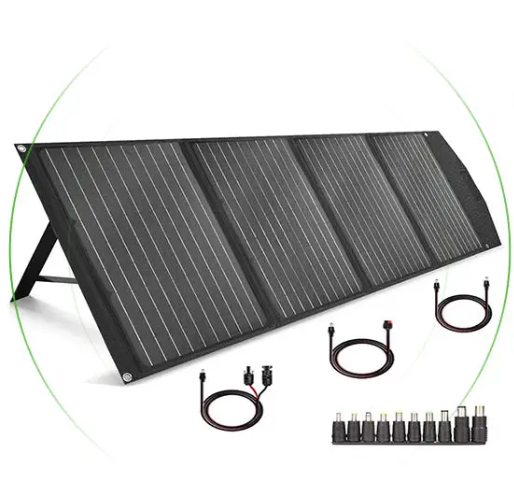
1) What “120 Watts” Really Means
Most solar panels are rated at STC (Standard Test Conditions): 1000 W/m² irradiance, 25°C cell temperature, and ideal spectrum. In the field, conditions are rarely STC.
A good rule of thumb for a quality 120W foldable panel:
- Typical real-time power: ~70–100W in strong sun (clear midday, decent angle)
- Best-case peaks: you may briefly see 110–120W with perfect alignment and cool temperatures
- Poor conditions: 10–60W in hazy skies, partial shade, or poor angle
Heat matters more than many people expect. As solar cells get hot, voltage drops. Many panels have a temperature coefficient around -0.3% to -0.4% per °C (varies by cell type). On a hot day, that can shave noticeable power off the top even under bright sun.
2) Daily Energy: Convert Watts into Watt-Hours
What you can run depends on energy per day, measured in watt-hours (Wh). A simple estimate:
Daily Wh ≈ Panel watts × Peak Sun Hours × System efficiency
Typical system efficiency (controller + cable + conversion losses) for portable solar is often 70–85%.
Example scenarios for a 120W Foldable Solar Module:
- Good summer day (5 peak sun hours):
120W × 5h × 0.8 ≈ 480Wh/day - Average conditions (3.5 peak sun hours):
120W × 3.5h × 0.8 ≈ 336Wh/day - Cloudy/shoulder season (2 peak sun hours):
120W × 2h × 0.8 ≈ 192Wh/day
So in many real trips, expect roughly 200–500Wh per day depending on location and weather.
3) What Can That Power?
Here are realistic examples using ~350Wh/day as a mid-range output:
- Phone charging (10–15Wh per full charge): ~20–30 charges
- Tablet (25–35Wh): ~10–14 charges
- Laptop (50–80Wh): ~4–6 charges
- 12V compressor fridge (typical 300–700Wh/day depending on heat and duty cycle):
A 120W panel may cover part of daily consumption, and can fully cover it in mild weather with good sun—especially if paired with adequate battery storage.
For AC appliances, remember the inverter adds losses. Running a 60W device for 5 hours is 300Wh, but plan closer to 330–360Wh after inverter inefficiency.
4) Why Foldable Modules Often Perform Differently than Rigid Panels
A 120W Foldable Solar Module is built for portability, not roof-mount perfection. Key performance-related features to look for:
- High-efficiency cells: many premium portable panels use mono cells around 20–23% efficiency, which helps in limited surface area.
- Controller type: MPPT typically harvests more energy than PWM, often 10–25% gains in cooler weather or when panel voltage is much higher than battery voltage.
- Kickstands / angle adjustment: aiming the panel can easily improve output by 20–40% versus laying it flat.
- Shade tolerance: even partial shade can cut power dramatically. Panels with thoughtful string layout can be more forgiving, but shading is always a big hit.
5) Quick Buyer Checklist
To build a reliable purchase plan:
- Choose the right output interface: MC4 for solar generators/controllers; USB-C PD if you charge devices directly.
- Use short, thick cables to reduce voltage drop (especially on 12–20V panels).
- Pair with a battery: solar is intermittent; storage makes it usable.
- Prioritize angle and placement: keep it unshaded and re-aim it 2–3 times a day for best yield.
Bottom Line
A 120W solar panel can produce up to 120W in ideal conditions, but most users should expect 70–100W during strong sun and about 200–500Wh per day depending on peak sun hours and system losses. If you tell me your location/season, what you want to run (fridge, laptop, power station model), and whether you’ll use MPPT, I can estimate your daily energy more precisely and recommend whether 120W is enough or if you should size up.
Post time: Jan-16-2026


